
Olwen Kelly: where material holds memory and quiet resistance
There is a moment, before a material is cut, altered or reassembled, where it resists. Not physically, but historically. It holds something. In Olwen Kelly’s practice, that moment is not something to overcome, but something to work with.
Based at La Catedral Studios in Dublin, Kelly’s work moves through textile, found materials and biodegradable substances, building a language where process is not separate from meaning, but inseparable from it. Her approach is grounded in repetition and variation, a methodology developed during her time studying Textile Art and Artefact at the National College of Art and Design, where making was understood not as the production of a single resolved object, but as a sequence of attempts. Forms are revisited, scaled, reworked. Nothing arrives fully formed.
This way of working extends into her choice of materials. Early experiments with communion wafers and luffa sponges introduced her to fragility, to decay, and to the idea that an artwork might not need to resist time, but instead move with it. Her degree project, centred on luffa as a grown material, imagined a future where textiles could be cultivated rather than manufactured. The logic is consistent: materials are not neutral carriers, but active participants.
A formative encounter with Alice Maher’s ‘Nettle Coat’ (1995) made from nettles and pins, slowly disintegrating, reinforced this position early on when she came across the work at Clifden Arts Festival during her time as a student at Clifden Community School. What remained was not the object itself, but the experience of its transformation.
This sensitivity to material as a carrier of memory becomes more explicit in Nests (2021–2025), a series of 43 small soft sculptures made from garments recovered from the former industrial school in Clifden, County Galway. The project began with a visit to the site before its redevelopment, where an outbuilding, once used as a laundry, still contained abandoned clothing. Kelly brought the garments back to her studio, washed them, and then waited.
The hesitation to cut into the fabric became part of the work. The resulting forms are small, almost contained, yet charged. They evoke nests, but not as symbols of comfort. Rather, they sit in a space between shelter and absence. In the abandoned architecture of the school, birds had begun to occupy what was left behind. The works mirror this quiet reclamation, while holding the trace of lives that had been removed from those spaces.
The Clifden Industrial School, run by the Sisters of Mercy, functioned not only as an orphanage but also as a site of labour, where children worked in laundries, bakeries and farms. Kelly’s response does not attempt to narrate this history directly. Instead, it operates through proximity, allowing the material itself to carry weight.
A similar approach underpins her most recent work, Tuam Excavation VIII, which responds to the ongoing excavations at the former mother and baby home in Tuam, Co. Galway where the remains of 796 babies are believed to be buried in the grounds. Here, the challenge is not only how to represent absence, but how to avoid representation altogether.
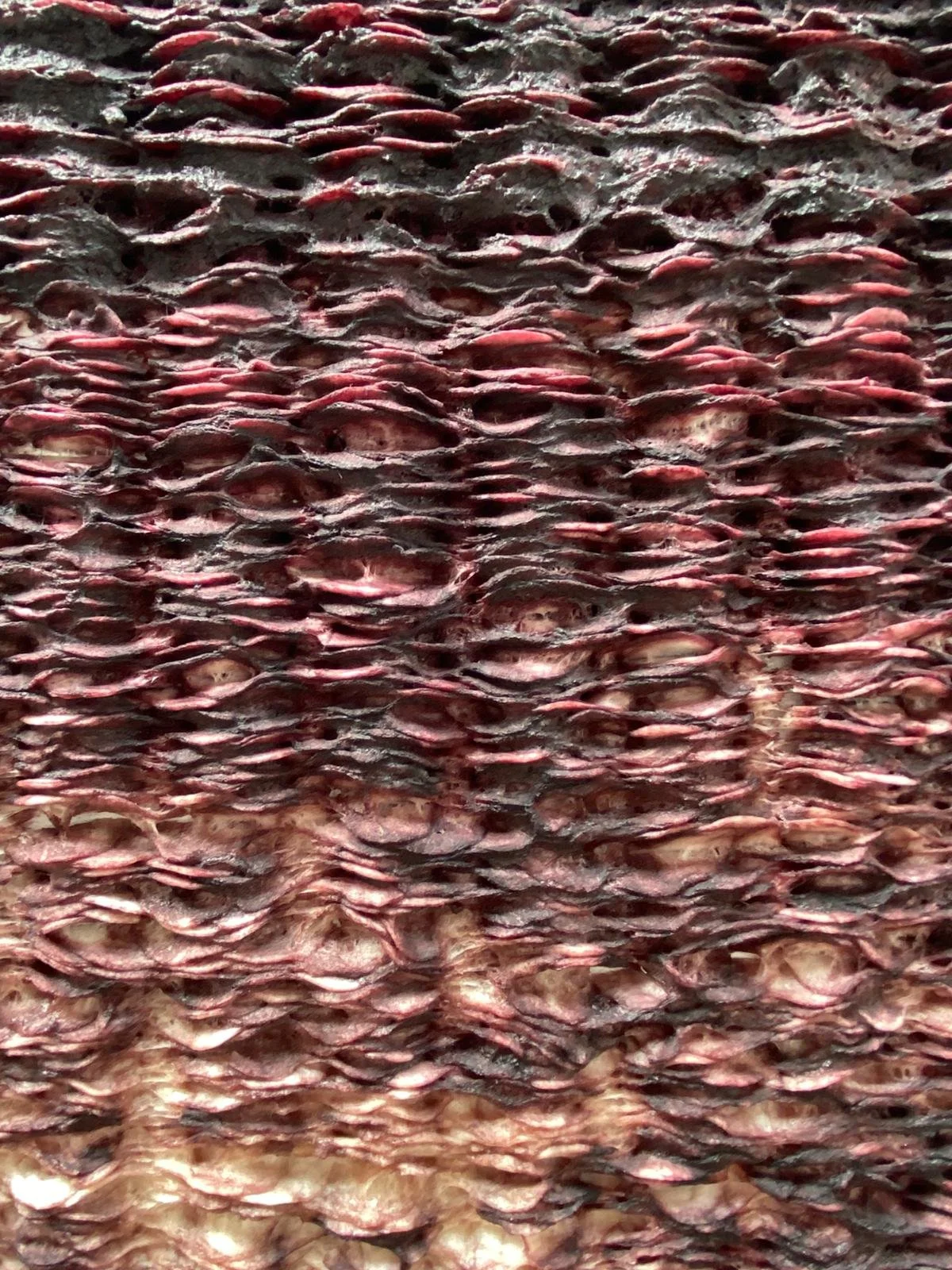
Kelly turns again to material. Deconsecrated communion wafers and wine are used to construct the work, drawing on their symbolic association with the body within Catholic ritual. As the wine oxidises, it darkens, taking on the appearance of soil. The wafers, pale and brittle, begin to resemble bone. The transformation is slow, continuous. The work does not depict bodies, but suggests their presence through process.
This choice of material also reflects a broader concern with biodegradability and the lifecycle of matter. The work changes over time, not as a side effect, but as a central condition. Decay is not an end point, but a language.
What emerges across Kelly’s practice is a shift in how art operates in relation to history. Rather than illustrating or explaining, it accumulates, absorbs, and reconfigures. While her earlier perspective positioned art as something that supports activism, her recent experience, particularly through sharing work online and receiving responses from audiences beyond Ireland, has reinforced its capacity to inform and resonate independently.
At La Catedral Studios, where she has been based since 2021, this process is both supported and extended. The studio provides not only physical space, but a context of exchange. Conversations with other artists, often informal, become part of the development of the work. Feedback circulates. Ideas shift. The presence of other practices, unfolding in parallel, creates a shared momentum.
It was also within this environment that Kelly completed her degree work, at a time when access to institutional spaces was limited. The Studios became both a site of production and a point of continuity.
Her current research is moving towards new materials, particularly copper, explored not only for its physical properties but for its role within systems of extraction, circulation and environmental impact. At the same time, there is a return to earlier concerns with sustainability, extending the line of inquiry begun with her luffa-based work Confronting Resilience.
Alongside her individual practice, Kelly is also involved in organising the upcoming Open Day at La Catedral Studios. The process, for her, has been one of translation, from individual works to a shared spatial narrative. Coordinating artists, arranging works in communal areas, and building connections between different practices has introduced a new layer to her understanding of how work is encountered.
If her own practice is concerned with how materials hold and transform meaning over time, this curatorial role extends that thinking into space, asking how works sit beside one another, how they speak, and how they are read collectively.
Kelly’s work does not attempt to resolve the histories it engages with. Instead, it remains with them, attentive to what persists, what shifts, and what resists being fully known.
Written by Federica Paletta