
John Paul McCann: Painting Between Roads and Records
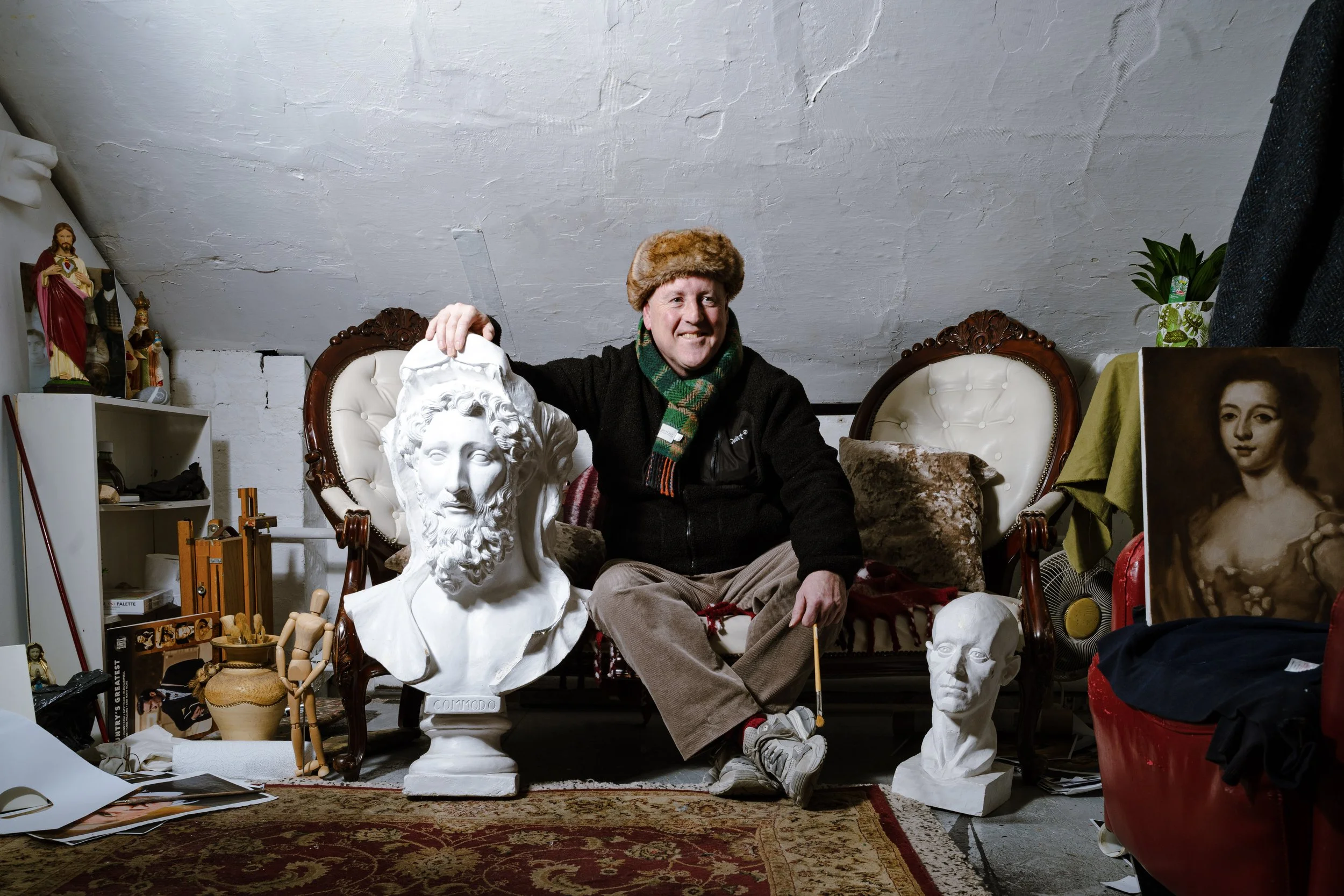
Photo by Aarif Amod
Born in Dublin in the 1970s, John Paul McCann came to painting not as an early vocation but as a quiet turning point. His journey into art began later in life, when a simple and deeply personal gesture changed direction entirely: an oil paint set, gifted by his sister for Christmas. From that moment, painting became both language and refuge.
Portraiture emerged naturally as the core of his practice. McCann is drawn to faces not as surfaces, but as carriers of presence. His paintings seek character rather than strict likeness, allowing the sitter to remain slightly out of reach, suspended between memory, observation and interpretation. Rather than reproducing photographs, he introduces subtle shifts and nuances, searching for what he describes as the soul of the subject, the point at which a painting begins to feel alive.
His visual language moves fluidly between classical traditions and older aesthetic echoes. He draws inspiration from artists such as Walter Osborne, Caravaggio, Rembrandt, Johannes Vermeer, Titian, Michelangelo, and John Singer Sargent, whom he considers the greatest portrait painter of all time. These references inform both his compositional approach and his use of colour, which plays a decisive role in his work. A vibrant, confident palette built around cadmium yellow, cadmium red, ultramarine blue and cobalt blue is used not simply to describe form, but to intensify atmosphere and emotion.
Life beyond Dublin has also shaped McCann’s artistic outlook. Extended periods spent abroad, including a year in Australia and months in Italy, Spain and England, expanded his sense of space, light and rhythm. Florence holds a particularly strong place in his memory, where he lived for seven months, studying and absorbing the city’s artistic legacy. His training and experiences included time at ateliers such as the Charles H. Cecil Studios and the De Angel Academy of Art in Florence, as well as the Sarum Studio Atelier of Fine Arts in Salisbury, England. Australia offered a contrasting landscape altogether: vast open spaces, kangaroos, vineyards and a sense of generosity that left a lasting impression, alongside the vibrant street art culture of Sydney.
Alongside travel, music runs as a quiet but constant current through his practice. The energy of Elvis’s early music, particularly from the 1950s, has directly inspired a series of portraits, approached not as historical documents but as reinterpretations filtered through mood, rhythm and memory. His listening extends beyond Elvis to artists such as Fleetwood Mac and Paul Simon, creating an atmosphere in the studio that feeds concentration and emotional tone.
McCann has exhibited his work at Pearse House and in Ranelagh, steadily refining a practice that remains deeply personal while open to dialogue. He was also among the early artists to join LCS, initially working in the Main Studios. Those early days were marked by an informal, almost domestic energy, including a brief and chaotic coexistence between his two canaries and Ophelia, the Studios’ resident cat, who showed far too much interest in them.
After a long absence, McCann has recently returned to La Catedral Studios. Coming back, he describes a strong sense of gratitude for the space he now occupies: a private studio with generous light and even a 19th-century chaise longue, which allows him to step back and study his paintings from a distance. He values the calm, the ability to listen to music quietly while working, and the sense of peace and focus the environment offers. The community remains central. He speaks with admiration of Antonella Scanu’s work ethic, describes Anthony Collins as a grounding, almost grandfatherly presence, and finds ongoing inspiration in fellow artists such as PJ Lynch and Alan Clark.
Now marking nearly twenty years since he first began painting, McCann speaks of his practice as something deeply therapeutic, rooted in commitment and care. He approaches each work with the intention of creating beauty, believing that when enough attention and honesty are invested, a painting can begin to breathe on its own.
Today, back at La Catedral Studios, John Paul McCann continues to develop his portrait practice within a shared creative environment that values time, patience and looking closely. His presence adds a steady, reflective voice to the Studios’ ongoing conversation, one shaped by memory, travel and the enduring intensity of the painted face.
Written by Federica Paletta